In recent weeks, as part of a new work regime which is designed to help me fit my musical and academic work alongside my fairly exhausting full-time, non-musical work, I have set myself a task of writing one miniature per week and, let me tell you, I have come to really take a lot of joy from miniature form. Each miniature (and I’m really aiming for something around the 1-minute mark here, though some are longer and some are shorter) is a tiny little laboratory in which my abstruse experiments can be conducted in peace. With longer works, and with works that I expect to have performed, I feel some pressure to make myself understood, at least by the performer, if not by the audience. This pressure simply doesn’t exist for these miniatures: all of my personal musical interests can find voice, uninterrupted by external calls for reason or clarity.
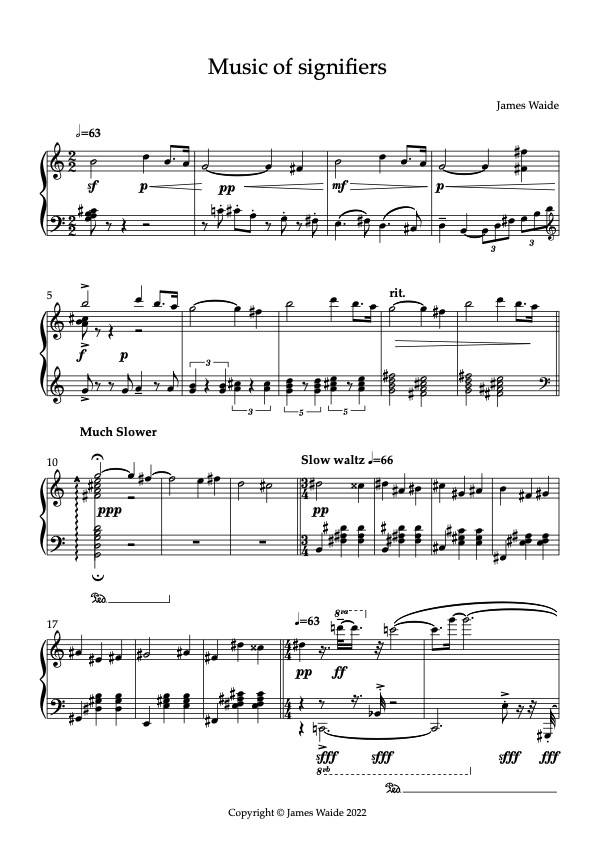
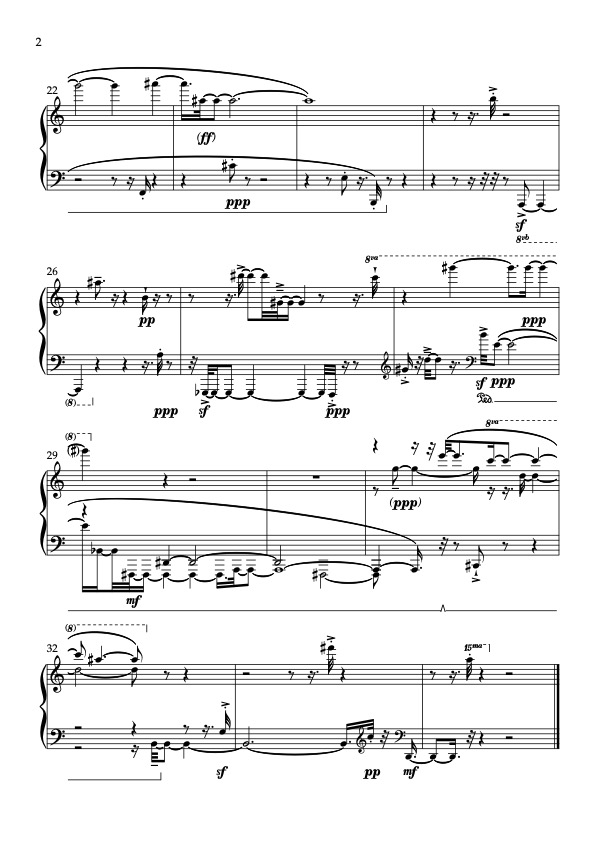
Take my most recent effort, entitled Music of Signifiers [score provided below]. A musing on a theme from Bruckner’s 5th symphony (this theme itself very reminiscent of Jack White’s guitar riff from Seven Nation Army) bleeds straight into a short, tonally adventurous waltz, which then moves directly into an extended section of music made using random number generation alongside Messiaen’s Mode de valeurs et d’intensités. Some may question why these fragments belong together, or what meaning they have when placed together, but I am simply not interested in answering these questions, at least not yet. These are signifiers which have been unexpectedly juxtaposed, whatever is the signified which emerges (or which I want to emerge) might take time now to form, but in the meantime I am happy for these signifiers to hang out, to grow acquainted with each other, to form their own relationships.
Composition, in any sense—whether musical or not—is the abstract arrangement of signifiers. Often, those signifiers are arranged in order to produce a richness of signification for the audience. For example: when, in a painting, I place people in the foreground, a lake in the middle-ground and mountains in the background, I am not only signifying people, lake, mountains, but also ideas of nature, of human interaction with nature, and of the order of importance of objects in the frame. If I change this order—mountains In the foreground, people in the middle-ground and lake in the background—the signification changes, perhaps in a way which is more challenging. Furthermore, if I paint kitchen furniture in the foreground, human face in the middle-ground and geometric shapes in the background, then the process of signification is much more difficult: the connections are less obvious and work is required to form those connections.
In my miniatures, I am able to lay the foundations for this kind of work. Firstly, I must simply present the composition of signifiers and then the process of signification can occur. Only from this kind of work may new patterns of expression (or clichés) emerge.
 James Waide