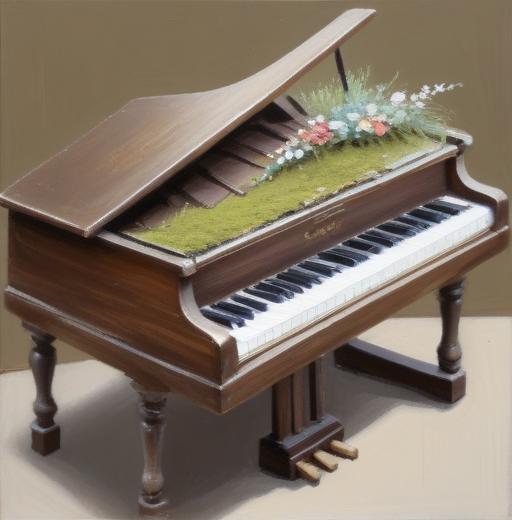
Laurence Osborn’s new piano concerto, “Schiller’s Piano”, which I had the immense pleasure of hearing in its premiere performance by Zubin Kanga and the Manchester Collective on Thursday 10th October, gives a shocking musical account of the construction of a replica piano in a Nazi concentration camp. The true story which informs the piece relates to a piano which was owned by the German poet, Friedrich Schiller. During the war, in order to preserve the piano, the Nazi regime relocated it to an underground bunker, replacing it with the lookalike made by captives at the Buchenwald forced labour camp. The resemblance extended only as far as the exterior of the instrument: on the inside, there were neither strings nor hammers, only a void. As the composer asked in a discussion before the performance, what better metaphor for fascism than this simplistic solution to a complex problem: an ornate facade, constructed in conditions of extreme violence, which masks a barren absence underneath?
Osborn’s music for keyboard is deeply concerned with the tensions and impossibilities which constitute the instrument itself. While other instruments are intimate supplements to the body of the performer—string and percussion instruments as extensions of the limbs, wind and brass as elongations of the respiratory system—the keyboard is an alien anatomy, a bizarre frame which is approached by minimal contact with the fingertips, as if one is touching something which could potentially explode if not handled with care1. In acting upon the foreign entity of the keyboard, through a series of mechanical transformations (and digital transformations, in the case of electronic instruments), the performer’s organic expression is converted into sound. This sound is harder to see as a direct communication of the player—as it is returned it acquires the form of the instrument. No matter how hard or soft one presses on a harpsichord key, the dynamic will be the same. Once a piano key is depressed, the sound will begin to fade. No matter what playing technique is used, a digital keyboard will only replicate the sounds it is programmed to replicate. It is a feature of keyboards which Osborn describes as “Autonomous” (as in his two works for harpsichord and ensemble, “Automaton” and “Coin Op Automata”), the idea that the instrument has a motivation of its very own which is in conflict with the motivation of the performer.
The automatous voice of the instrument is the space of an ideology which interpellates performers in musical discourse. The pianist is not the person who plays the piano, but the person whose identity is found in reflection from the piano: the sound of the piano retroactively hails its player as the person whose desire it was to have made the sound. The reflectivity of musical instruments is the mechanism through which their players come to identify with them. As previously discussed, the embodied experience of many types of instrument is visceral and close for the performer; the identification process is simpler for the player who holds their instrument to their mouth or who cradles it to their chest. But what kind of bizarre second body does the pianist acquire in the funhouse mirror of the 9-foot concert grand?
Perhaps it is not surprising that the piano was the height of musical technology at the onset of the industrial revolution: what better accompaniment for the age of mechanisation and automation than this device which converted minimal input into maximal affect? The piano was the instrument for an age in which organic nature, with its inefficiency and indifference to progress, had been successfully overcome by the aims and ambitions of the machinery which restrained it. In the words of Adorno: “What human beings seek to learn from nature is how to use it to dominate wholly both it and human beings.” In this way, the Piano is an extremely apt instrument for a story which comes from the darkest depths of humankind’s propensity to dominate and destroy.
Osborn’s concerto spins a structure around the construction process of a piano. A large amount of the time, the soloist is using a Midi keyboard to trigger sampled sounds from a piano workshop: the noises—of wood being sawed, of felt being nailed into the frame, of wire being cut and tuned—situate the piece in a relationship with the materiality of its instrument. Perhaps it is not insignificant that this material only exists in the computer-space of the electronic keyboard: the most materially grounded of the sounds being situated in the least tangible of the available instruments. At a very significant moment, notes from the piano are played alongside the sounds of the strings being stretched during the tuning process, creating a kind of impossible portamento effect on the piano. All these noises of wood and wire remind us that the piano is an array of organic and/or flexible materials which have been engineered into a state of precision and inflexibility. Like the labour camp in which prisoners were forced to build the replica of Schiller’s instrument, the piano itself imposes restrictions upon the people who play it; any expression of personality through the instrument is possible only via the tight boundaries imposed by the structure.
How do we save the piano from this totalitarian nightmare? Perhaps there is an answer in the concerto. The replica of Schiller’s Piano is only one piece of musical notoriety to come from Buchenwald; the other is the Buchenwaldlied, a song which was composed by prisoners at the camp at the behest of the Nazi commanding officer at the camp and which makes an appearance towards the end of the concerto. The song’s melody was a simulation of upbeat German folksongs of the kind which might have been very popular with Nazi authorities, but the lyrics tell a complex story: the song’s workers who go into the forest at the break of day may seem to resemble the happy and innocent labourers of nationalist orthodoxy, but the workers in this song don’t simply carry bread with them into the woods, they also carry their sorrows; the sun doesn’t rise to greet the labourers, it rises to laugh at them as they are stuck within their fate at Buchenwald. A particularly astounding image of freedom permeates the lyrics of the song, especially in the refrain of “We still want to say “yes” to life, because one day the day will come – then we will be free!” It is telling that not only did the camp’s officers demand that the interns sang this song, but also there are reports that the prisoners chose to sing the song as an act of resistance which somehow flew under the radar of the authorities. Perhaps this song has the structure of an empty piano: if you do not look closely then the melody is bright and colourful enough to mask the chasm of despair held by the lyrics.
The song’s appearance in the concerto, sang quietly by the soloist into the body of the piano, reveals this very double-life in the face of restriction. it is a moment of intimacy and organicism which cannot originate from the piano, but it is a moment which exists for the piano, rather than for the audience. A piano may be all of the things that have been described above—a strange alien entity, a distorted mirror of the performer, an oppressive machine—but it can only be those things because we have made it so. When a performer plays the piano, they provide the energy and the impetus for the piano to come to life; it may be automatic, but (just as an automatic door runs on power from the mains) it still needs power from the performer in order to run. All instruments are alien extensions of the body, all machines are restrictions of the organic body, all pianos are empty pianos, and all songs are propaganda, but within these limits we can find an image of ourselves which extends beyond the limits themselves. Music is not the materials which make music, but what is lost from those materials when the sound reaches our ears.
A technological development that seems to predict the cold horizons of places we access through modern computing, which finds it zenith in the incorporeal worlds of virtual reality headsets. Perhaps the musical equivalent of these VR devices arose almost a century earlier in the form of the theremin, an instrument which cannot even be touched. ↩︎
 James Waide