A message I wrote to myself on the occasion of missing a deadline

Friday, 2nd September 2022

Douglas Adams’ famous quote, I love deadlines. I love the whooshing noise they make as they go by gives very little comfort in the days leading up to a deadline. If you don’t make the target, it gives even less comfort in the days that follow. Completing a piece of work is incredibly satisfying, but grappling with trying to finish a piece of work which just doesn’t seem to be coming together, while the clock ticks over the point that it should have been ready entails a special kind of personal torture.

Now is the time to consider your failures: you failed to make good on your promise to deliver something within a certain timeframe; you failed to live like a motivational poster and overcome your difficulties in order to turn in your work; you failed to overcome the awful self-doubt which, despite years of therapy, still rips through you like a cannonball through a sail-cloth; you failed to show the world that you are the best version of yourself and that anyone who ever doubted you, insulted you or rejected you was clearly in the wrong.

Gosh, how did that thought process capsize so easily. How quickly you let your thoughts whirlpool when you meet setbacks. Deep down, perhaps you believe that the worst things anyone has ever thought about you are true.

You ask yourself:

If I’m unable to function when my thoughts spiral to these deep places, does that make a shallow person?

Down in the murky bottom of your consciousness, where you can almost imagine that you’re able to make out your unconscious fears and desires, everything is held by impenetrable glass walls, which defy reason by becoming less transparent the more you look at them. There’s the job you didn’t get; there’s the competition you didn’t win; there’s the criticism you never understood; there’s the first date which never led to a second; there’s the person who hurts you still, despite all this time that’s gone by. But they all fade away back into the darkness as soon as you see them.

Tight deadlines force you to swim in deep waters, but it’s not just deadlines, creative work in general can ask this of you. How can you swim in these waters, amongst the asphyxiating rogues gallery of your psychic life, and come out victorious?

Sometimes, you have to give up and rise back to the surface. Do you feel defeated? You can hear the commentary of the imaginary spectators, who simply don’t see you as someone who’s up to the task. You’re worried that they might be right. It’s hard to live like the obsessed hero who continues on the correct path despite the cynical voices pushing her back when you identify with the cynical voices and not with the hero. The best you can do is find a way continue in the shallow water for now, while you plan for your next excursion into the paralysing depths below.

At least at the surface you can breathe. Let’s acknowledge something now: it is within your power to finish the work which is still unfinished, you can undertake the small tasks which will carry you at least somewhat towards your goal and you will never regret having made progress, even if the progress is only limited. For now, we must simply swim on, taking whichever route seems possible. The goal remains in sight.
James Waide wins 2nd Prize in the 1st Annual Wizarding School Composers Competition

James Waide has won the 2nd Prize in 1st Annual Wizarding School Composers Competition. The prize will allow James to study and undertake professional development with Joseph Sowa, the organiser of the competition. James won for his Sonata for Piano, composed 2020-21, and available to listen to on his Soundcloud.

Joseph Sowa’s Wizarding School for Composers “aims to fill the gaps left by university composition programs, by connecting the essential technical skills composers learn at music school with practical creative workflows, timely career advice, and the latest music cognition research.”

God, Philip Larkin and Prom 49

28th August, 2022

What is a religious experience? I think I may have had one.

I’m a sceptical sort, disbelieving to a fault; disbelieving of myself and of those around me. This general disbelief certainly carries over to my views on religion. People who knew me at school may remember that I was a teenage athiest of the most tedious variety; I watched videos of of Richard Dawkins hectoring the faithful to be less gullible, and of compilations Christopher Hitchens being rude to preachers (so called “Hitch-slaps”, a cringeworthy expression to me now, but ashamedly not so much when I was 16); I started arguments with religious schoolmates and, on one occasion, I wrote a screed in my Religious Studies work-book (for such a subject was apparently considered valuable by my school) in which I suggested religious belief was akin to supporting the Ku Klux Klan. I was, to put it far too mildly, a pain in the arse.

The aforementioned Hitchens often cited a favourite poem of his by Philip Larkin, Church Going, in which Larkin, an atheist, describes a church as “a serious house on serious earth”. What is the seriousness of the place to a non-believer? I have often asked myself this question myself: as I sat respectfully through Catholic weddings and funerals; as I participated in Anglican services at school (my general flippancy was always muted within the buildings themselves); as I marvelled while touring grand European cathedrals; as I was emotionally affected by religious art and music. These are all experiences which are almost unique to religious institutions and they seem to find some ascetic need for deep seriousness within us. God need not exist for these experiences to be felt.

I had a most jarring experience one day in 2015 as I was listening to Hindemith’s Ludus Tonalis. The music made me feel something quite profoundly moving—my trunk was shaken to see if any roots would come out. And it seemed like they would when, out of the blue, a thought seemed to pop into my head: “God Exists”

Now, I remain an atheist to this day and this blog post is certainly not a place for ontological examinations of God, so let’s just marvel at the possibility that someone could have such a shocking thought while listening to a piece of music, especially a piece of secular, mid-twentieth-century piano music. If I had held on to that thought, then I could have converted to a religion that I previously had no intention to follow simply because of a piece of music. Thence comes the power of the idea of God: of a being which is able to feel profound and unexpected feelings to the extent that we would form a belief system around it. And this is something that music did to me. There are few things in life which can get us to be so serious about such vast and unimaginable experiences.

This has been present in my mind this week because of prom 49, which featured a performance of Mahler’s 2nd symphony by the LSO under the baton of Sir Simon Rattle and which I was exceedingly fortunate enough to attend. It was, for me, one those extremely rare occasions: an experience of jubilation and euphoria far beyond anything encountered in daily, mundane life. It was, I reflected as the applause thundered around the whole hall following the final bars of the piece, surely the same experience that believers have when fully enrapt in their religious practices, it was a kind of powerful emotional totality that one just simply doesn’t usually experience. I entered into communion with the musicians, the audience, Mahler, the music—I was overwhelmed beyond my wildest dreams.

Serious experiences are valuable and they are hard to come by, especially in secular life, hence why atheists visit churches and celebrate Christmas etc. Maybe, the feeling of powerful music can give us a hint as to how we can gain these experiences without feeing that we need to take brand new epistemological and ontological positions?

How rhythm leads to signification in football, music and life.

21st August, 2022

I write this, having just watched Newcastle United hold Manchester City to a 3-3 draw in the Premier League. By 63 minutes, all of the goals which would be scored were scored and, as the clock ran on towards the end of the match, so too did a tense expectation arise; something was due to happen. Another goal could have been scored, causing one of these teams to leave the pitch as victors but, despite flurries of activity, no decisive action arose. So what was the expectation, what was the guaranteed outcome that we awaited?

The silence which follows any activity is a moment in which a great deal of signification occurs. Once we are past the relentless onslaught of bustle, we have a moment during which we can digest that which we have just consumed. In the context of a football match, the time following the full-time whistle is when the fans, the players, the managers and the pundits all throw their analyses into the ring. The time when the match is absent is the time when the match may be perceived as a whole entity, rather than something unfinished which is still unfolding. As a match reaches its conclusion, we anticipate the moment when it will finally be over and we can begin to understand what we have seen.

This is the rhythm of presence and absence, of continuity and discontinuity. It is an essentially musical aspect of life. In the words of Ferruccio Busoni:

That which, within our present-day music, most nearly approaches the essential nature of the art, is the Rest and the Hold (Pause). Consummate players, improvisers, know how to employ these instruments of expression in loftier and ampler measure. The tense silence between two movements—in itself music, in this environment—leaves wider scope for divination than the more determinate, but therefore less elastic, sound.

Busoni, F. (1907). Entwurf einer neuen Ästhetik der Tonkunst. Trieste: Schmidl; trans. by Theodore Baker as Sketch of a New Esthetic of Music. New York: G. Schirmer, 1911.

Music is an art-form which is fundamentally made of the tension between presence and absence; the craft of music lies in learning how to control this relationship. Busoni’s reference to the silence between movements is especially interesting to me, as I recently attended a few concerts at this year’s proms, where I have noticed a tendency for audiences to clap between the movements. My intention here is not to pass judgement one way or the other on the debate about whether audiences should be discouraged or encouraged to do this, but simply to observe that, in clapping, the audience fills the silence during which a movement may be considered as single contiguous entity, and therefore they resist the process of signification which would otherwise occur.

This all reminds me of the many covid lockdowns which occurred in 2020 and 2021. These lockdowns were, for those of us who were not key workers, a kind of extreme silence: an extended period of absence disrupting the continuity of life and changing the nature of life’s rhythms. These were extremely significant times, during which we became far too familiar with our own company. We sought to fill our lives with with zoom calls, Netflix binges and, yes, applause (clap for the NHS, anyone?). This was a defensive resistance to signification, for we were naturally terrified of things which could have been signified had we allowed the silence to creep in for too long.

Psychoanalyst Ludovica Grassi highlights the essentially musical foundations of our lives. This kind of rhythm has been present with us since at least our births, if not before.

The elements of continuity that make up the foundations for the homeostasis of the foetus’s organism are interrupted at birth: the rhythm of meals replaces the continuous flow of nutritive substances through the umbilical cord; so does the rhythm between sucking and swallowing …; the provision of oxygen previously supplied by … the mother must now be obtained by an autonomous respiratory system …; the continuous and reassuring sound of the mother’s heartbeat gives way to the newborn’s autonomous cardiac activity

Grassi, L. (2021). The Sound of the Unconscious: Psychoanalysis as Music. Abingdon: Routledge.

Our life is segmented by rhythm, and it is only this segmentation which allows us to divide our lives into chunks which allow for easy signification. Thus, the power of music: in controlling this flow of signification via rhythm, a musician works with one of the most fundamental and primal parts of our human experience.

Anyway, I think it’s time for me to go and watch Match of the Day to find out what Gary Lineker thinks this result signifies for Newcastle’s season.

Hiding in the weather

It’s been pretty hot around here recently. Weather systems come and go over Manchester with disregard for the residents of the city. This heatwave came at a very crucial time in my life; I am between jobs, I am growing my teaching business, I am working to meet a deadline for a composition, I am expanding my website, I am keeping up with a load of reading which will be essential for future projects. I am sat at my desk, sweaty and exhausted under this unusually hot weather. There’s an expression: when it rains it pours—perhaps we can come up with an alternative: when it simmers it boils.

How is our inner life like the weather? Moods and mental states pass over us like chaotic systems of high and low pressure. Events have a way of amalgamating, so that small breezes (conflicts, jobs, personal matters, health concerns etc.) build into hurricanes before we are quite ready for it. We are clouds: enjoyable, white, fluffy, almost whimsical—turned menacing, dark, gloomy. When are we ever in control of the meteorological events of our lives? Perhaps we never really are, we just learn how to ride them out and how to barricade against the worst of it, the worst of ourselves.

In L’Étranger, Meursault (the protagonist of Camus’ novella), is controlled by the unbearable, scorching Algerian sun, to the point that it may well be blamed for an act of violence. How terrifying to see that person, who rides through life as a weather pattern: impersonal, object, emergent property of factors apparently without control. And how terrifying to be that person, when we find ourselves in the midst of a storm that we did not intend.

I am currently working on a piece for voice and piano which combines several texts relating to weather. My aim is to create a character piece, in which the music depicts something of the feeling of retreating into the objectivity of weather. Yet this retreat cannot be completed, we are subjects and our subjective selves survive despite our best attempts at rending ourselves as objects. Music provides this subjectivity: music cannot exist without the subject who made the music and the subject who listens to the music; music forces emotive responses because of its role as a kind of proto-language which doesn’t contain the semantic value of other languages and which, therefore, cannot be reasoned with towards to objective conclusions. Music can signify the parts of ourselves where our subjective experience cannot help but break through; it is a compass which points us away from our hiding place in the objective reality of weather, and which encourages us to face our subjective life as the person who experiences weather.

It is a very difficult thing to accept the stress that emerges in the stormiest moments of our lives, it is much easier to search for hiding places. But the only way to grow to meet the difficulties of life is to face them and accept our role within them.

Writing miniatures and composition of signifiers

In recent weeks, as part of a new work regime which is designed to help me fit my musical and academic work alongside my fairly exhausting full-time, non-musical work, I have set myself a task of writing one miniature per week and, let me tell you, I have come to really take a lot of joy from miniature form. Each miniature (and I’m really aiming for something around the 1-minute mark here, though some are longer and some are shorter) is a tiny little laboratory in which my abstruse experiments can be conducted in peace. With longer works, and with works that I expect to have performed, I feel some pressure to make myself understood, at least by the performer, if not by the audience. This pressure simply doesn’t exist for these miniatures: all of my personal musical interests can find voice, uninterrupted by external calls for reason or clarity.

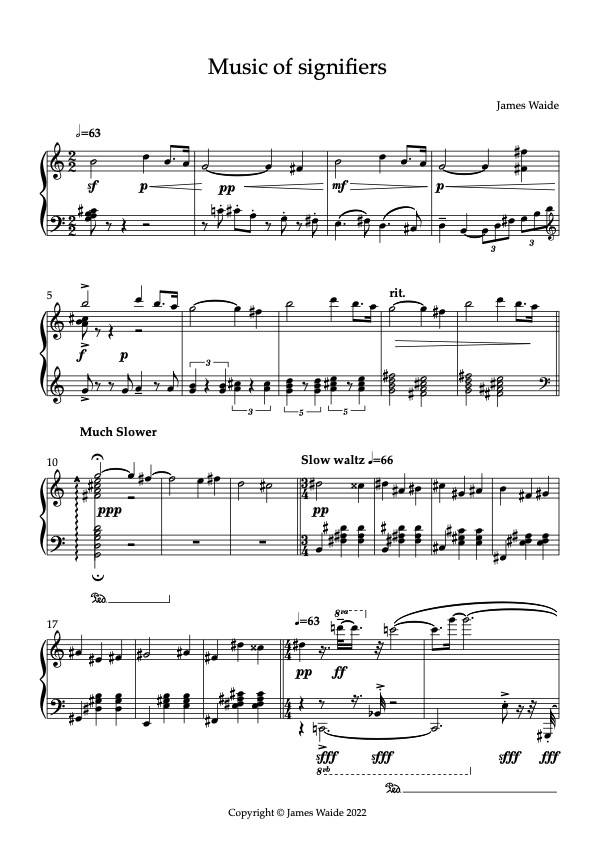
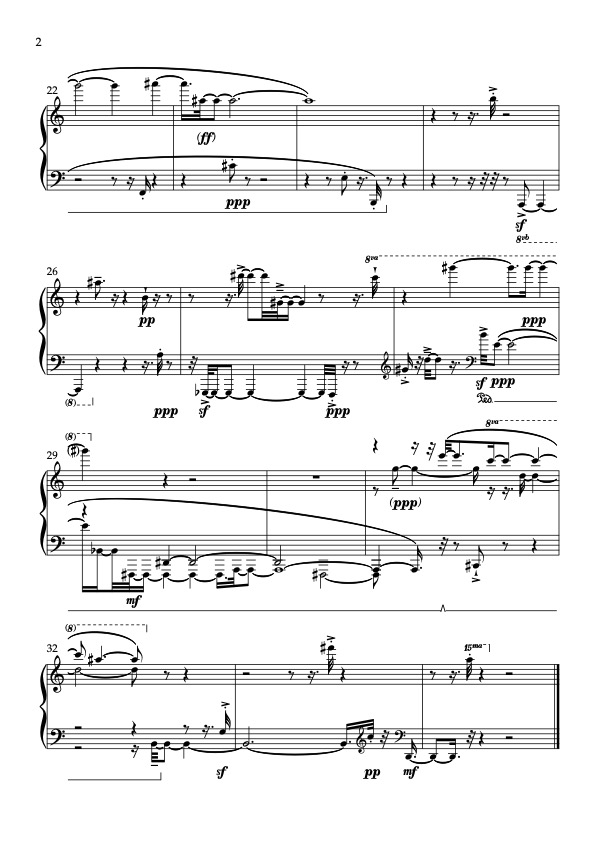
Take my most recent effort, entitled Music of Signifiers [score provided below]. A musing on a theme from Bruckner’s 5th symphony (this theme itself very reminiscent of Jack White’s guitar riff from Seven Nation Army) bleeds straight into a short, tonally adventurous waltz, which then moves directly into an extended section of music made using random number generation alongside Messiaen’s Mode de valeurs et d’intensités. Some may question why these fragments belong together, or what meaning they have when placed together, but I am simply not interested in answering these questions, at least not yet. These are signifiers which have been unexpectedly juxtaposed, whatever is the signified which emerges (or which I want to emerge) might take time now to form, but in the meantime I am happy for these signifiers to hang out, to grow acquainted with each other, to form their own relationships.

Composition, in any sense—whether musical or not—is the abstract arrangement of signifiers. Often, those signifiers are arranged in order to produce a richness of signification for the audience. For example: when, in a painting, I place people in the foreground, a lake in the middle-ground and mountains in the background, I am not only signifying people, lake, mountains, but also ideas of nature, of human interaction with nature, and of the order of importance of objects in the frame. If I change this order—mountains In the foreground, people in the middle-ground and lake in the background—the signification changes, perhaps in a way which is more challenging. Furthermore, if I paint kitchen furniture in the foreground, human face in the middle-ground and geometric shapes in the background, then the process of signification is much more difficult: the connections are less obvious and work is required to form those connections.

In my miniatures, I am able to lay the foundations for this kind of work. Firstly, I must simply present the composition of signifiers and then the process of signification can occur. Only from this kind of work may new patterns of expression (or clichés) emerge.

Music of Signifiers – page 1
Music of Signifiers – page 2

Resistant listening: Tchaikovsky and me

As a teenager, I really tried to avoid listening to Tchaikovsky. Understanding exactly why this was so requires some difficult self-reflection of the sort that I would be hesitant to undertake, but suffice it to say that as an adult I overcame this dislike and I’m now very fond of much of Pyotr Ilyich’s work. In his book chapter, “Symbolic listening: the resistance of enjoyment and the enjoyment of resistance”1,  Jun Zubillaga-Pow explores how the psychoanalytic concept of resistance helps us to understand how we listen to music. Put simply, resistance is a kind of opposition to realisation and it is enacted in multiple different ways: we may become extremely emotive or we may become extremely cognitive, but it always has the effect of preventing an engagement with something which may facilitate a realisation of the unconscious. When we listen to music, we experience this resistance in the form of strong emotive responses, either towards or against the music, or in the form of cognitive-analytical behaviour. When I say that to understand why I disliked Tchaikovsky as a teenager would require difficult self-reflection, I mean that I would have to examine in the way in which the music formed meaning within me via my resistances, and this could facilitate uncomfortable self-realisations.

The same could be said of my journey with Abba, a similar journey from disliking to liking, or of the kinds of music which I still choose not to listen to, such as music of the Metal genre; many pieces by Rachmaninov; all pieces by Einaudi; or any performance of any kind by André Rieu (to name but four of many possible examples). It is easy, when we dislike a piece of music, to decry it in strongly emotive terms. It is harder, but still somewhat easy to musically educated people, to construct clever intellectual reasons to dismiss and devalue the disliked music. What is truly difficult is to carefully examine our subjective dislike of something and thus to understand what this music really means to us. Understanding the subjective meaning of a disliked piece of music involves a reflexive understanding; the thing we dislike in the music might well reflect on some equal part of ourselves.

To acknowledge that we dislike something is to acknowledge that something has meaning to us. If we then refuse to engage with this thing, then we refuse to realise that meaning. If we want to understand ourselves better, then we should listen to music that we dislike, we should carefully consider the undesirable feelings that the music stirs up and should wonder, “why this feeling from this music?” Of course, the really scary thing is that we might get the answer to that question.

At the very least, take this as a reason, if one is required, to be less judgemental of people who like music that dislike. After all, do we have the courage to undertake the reflective task of tracing the yet-unconscious roots of our resistance? Until we have truly understood our dislike, then we cannot truly know if some selfish motive lies beneath our reaction.

1Zubillaga-Pow, J. (2018). Symbolic listening: the resistance of enjoyment and the enjoyment of resistance. In S. Wilson (Ed.), Music—Psychoanalysis—Musicology (pp. 151-163). Routledge.

Musical Borrowing is a lot more common than you might think

Thursday 21st June, 2022

When I began writing my MMus dissertation on the subject of Musical Borrowing (a musicological field pioneered by J.P. Burkholder), I expected I would be looking at something idiosyncratic and fairly unique to a few compositions by many composers and many compositions by a few composers. For instance, Beethoven seems on first glance to rarely make use of references to other compositions but, in works such as the 22nd Variation in the Diabelli variations, he does occasionally engage in quotation and allusion. Meanwhile, Charles Ives weaves quotation, allusion and reference through many of his of his works to the extent that it is a stylistic hallmark of his. I felt I could categorise composers by the frequency with which they borrowed, e.g. Ives and Schnittke borrowed very frequently, Stockhausen borrowed sometimes, Beethoven and Mozart borrowed rarely, Yoko Ono and Morton Feldman borrowed almost never (I do not claim that this categorisation is accurate, simply that it is an example of how such a categorisation might be organised).

The lines got a little muddy when talking about allusion to a style of music otherwise alien to the genre of the piece (for instance, the baroque-style theme of the 2nd Mvt of Schnittke’s first symphony) as this was both an original piece by Schnittke but also a reference to a category of pieces not by Schnittke. Furthermore, what of Pierre Boulez, who admitted that early in his career he was working in line with classical conceptions of form before he made a break with this following his 2nd Sonata. In both instances, Schnittke and Boulez, both are deliberately using ideas from older music, but only one of the pieces (the Schnittke) is attempting to sound like its model, while the other works very hard to avoid sounding like anything familiar. If these are both examples of musical borrowing, then we must look at other musical works with fresh eyes: whether a piece sounds like an older piece or not, if the newer uses some aspect of the older then it is an example of musical borrowing. Thus, pop songs which use familiar chord patterns, classical-era sonatas which build upon a shared model of “sonata”, folk-tunes which use a structure from an earlier folk-tune; these are all examples of musical borrowing.

In my dissertation, I propose this new typology for musical borrowing:

  1. Music is borrowed when elements which can clearly be identified with an earlier work or composer appear in later work by another composer
  2. Music is borrowed when elements which are associated with a particular musical tradition appear in a new work
  3. Music is borrowed when shared cultural ideas appear in a piece of music
  4. Music is borrowed when it makes use of a shared musical language

My suggestion is that musical borrowing, far from being a strange and idiosyncratic style, is actually a necessary fact of musical composition which extends as deeply as the shared musical language which all musicians use.

I hope soon to publish my dissertation here on my website, but I hope that in the meantime this will serve as a taster of some of the thought-processes which went into writing it.

Two Exciting Premieres next week!

On Thursday 9th December, I will be conducting a concert at Mill & Honey Café, Manchester, featuring work by myself, as well as composers Xia-Leon Sloane and Nate Chivers. This concert will feature the premiere performance of “Meditative Music”, a piece I wrote in 2017 and which I have sat on for all this time before deciding to unleash it at this concert. The concert will feature an hour of calming and meditative music; it will be a much-needed moment to slow down amid the hectic business of December! The concert begins at 7:30pm and we will be asking for a voluntary donation of £3 towards the operations of St. Peter’s House, the chaplaincy to Manchester’s universities, who are currently running a project to support struggling students with free food parcels.

Then, on Friday 10th December, my new orchestral work, “Part One”, will be performed by the Brand New Chamber Orchestra at the Royal Northern College of Music, alongside works by Gavin Higgins, Eden Longson, Heléna Walsh, Matthew Holmes, Henry Page, Tak Wong and Ethan Mitchell. The concert will start at 7:30pm and tickets, which cost £5, are available here.

YouTube Concert – Premiering Thursday 6th May at 7:30pm

Over the last year, postgraduate composers from various UK conservatoires have been coming together on Zoom to share work and ideas in seminar settings. This Concert—featuring music by composers at the Royal Academy of Music, the Royal Conservatoire of Scotland, Trinity Laban and the Royal Northern College of Music—is a continuation of those events and functions as a showcase of the diversity of music-making going on at conservatoires up and down the UK.

In this concert you will hear:

Pudesse Eu – Rodrigo Cardoso (RNCM)

Ankylosing – Josh Kaye (Trinity)

Ceasg – Siobhan Dyson (RCS)

Near Stasis – Yu Hng (RAM)

Seven Days – Matthew Sear (Trinity)

Prelude for Unaccompanied Cello – James Waide (RNCM)

Anne Hathaway from the World’s Wife – Thomas Green (RCS)

This concert was produced as collaboration between Geoff King, Rylan Gleave, Josh Kaye and myself.